


All Products
-
 Global Power Solution EngineerStable quality, on-time delivery, reliable long-term partner.
 -
 Gulf Electrical Engineering SeProfessional technology and perfect after-sales service.
 -
 International Power Research LCustomized solution meets our project requirements perfectly.
 -
South America Electric Power PProfessional team, good communication and stable supply.

Hand‑held On‑Load Tap Changer Tester OLTC Analyzer for Transition Time & Resistance Test


| Place of Origin | China Mainland |
|---|---|
| Brand Name | MINGYANG |
| Model Number | MYKS |
| Minimum Order Quantity | 1 |
| Price | 2200usd |
| Packaging Details | carton |
| Delivery Time | 1 week |
| Payment Terms | L/C,D/A,D/P,T/T,Western Union |
| Supply Ability | 1000pcs/month |
Product Details
| Measuring Range | 1-1999μΩ | Accuracy Class | 0.5% |
|---|---|---|---|
| Operating Temperature | -10℃~40℃ | Time Resolution | 1s |
| Current Resolutio | 1μΩ | Place Of Origin | Hubei, China |
| Resolution | 1μΩ | Measurement Accuracy | 0.5% |
| Measurement Range | 1-1999μΩ | Working Power Supply | AC220V ± 10%, 50Hz ± 1Hz |
| Weight | 12kg | Display Mode | Three-and-a-half-digit LCD |
| Volume | 380*350*260 Mm | Type | Testing Machine |
| Protection Class | IP55 | Customized Support | OEM, ODM, OBM |
| Accuracy | 0.1 | Voltage | 220 V |
| Warranty | 2 Years | Power | AC220V |
| Output Current | 1.0A,0.5A,0.2A | Transition Time | 0~320ms |
| Transition Resistance | 0.3Ω~20Ω(1.0A) 5Ω~40Ω(0.5A) 20Ω~100Ω(0.2A) | Open Circuit Voltage | 24V |
| Environment Adaptation | ≤85%RH | Ambient Temperature | -10℃~50℃ |
| Working Power | Battery Powered | Power Frequency | 50±1Hz |
| Highlight | Portable Transformer Tester,Handheld Transformer Tester,IP55 transformer analyzer |
||
Product Description
Hand‑held On‑Load Tap Changer Tester OLTC Analyzer for Transition Time & Resistance Test
Product Description
This high-intelligence instrument features easy operation with Chinese menu prompts. Compact, lightweight, and with strong anti-interference capability, it significantly reduces field work intensity. An ideal solution for ensuring safe production and improving quality in power supply units and transformer manufacturing.
Product Alias
Portable OLTC Characteristic Tester / Handheld Transformer Tap‑Changer Analyzer / Transformer On‑Load Tap Switch Parameter Tester / OLTC Transition Time & Resistance Measuring Instrument / Field‑use Tap‑Changer Performance Detector
Features
- High output current capability with minimal device weight
- Direct resistance value display for YN, Y, and D-type transformers without conversion
- Measurement capability for transformers with and without windings
- Automatic adjustment of resistance and time values based on sampling data
- 7-inch high-brightness touch color LCD with clear visibility in bright light and Chinese/English language switching
- Automatic storage for 500 data groups
- Built-in lithium battery power supply for outdoor convenience
- External printer connectivity for measurement data printing (optional)
Product Parameters
| Output Current | 1.0A, 0.5A, 0.2A |
| Measuring Range | Transition Resistance: 0.3Ω~20Ω (1.0A), 5Ω~40Ω (0.5A), 20Ω~100Ω (0.2A) Transition Time: 0~320ms Open Circuit Voltage: 24V |
| Measurement Accuracy | Transition Resistance: ±(5%±0.1Ω) Transition Time: ±(0.1%±0.2ms) |
| Resonant Frequency | 20kHz |
| Storage Method | Local storage |
| Dimensions | Main Unit: 252*160*65 mm Outer Box: 425*335*210 mm |
| Weight | Main Unit: 2 kg Outer Box: 8 kg |
| Test Lead Length | Standard 13 meters (customizable length available) |
Application Scenarios

FAQ
Question 1: What test items can this handheld on‑load tap changer tester complete for power transformers?
Manufacturer: This handheld OLTC tester is specially developed for on‑load tap changer preventive test. It can measure transition waveform, transition time, transient transition resistance, three‑phase synchronism and contact bounce condition. It judges contact ablation, spring fatigue and switching abnormity of tap changer. It is compatible with multiple winding connection types including Y, D and Yn transformers. With color touch‑screen, local waveform storage and USB data export function, test waveforms and reports can be exported for archive. Widely used for transformer factory delivery inspection, substation routine maintenance and fault diagnosis.
Question 2: Measured transition waveform is disordered and distorted, what are the possible causes and solutions?
Manufacturer: Distorted waveform is mostly caused by poor contact or field electromagnetic interference. First, check all test clamps, remove paint, oxide and rust on tap‑changer terminal studs, ensure tight metal‑to‑metal connection. Second, arrange test cables away from high‑voltage live equipment and power cables, avoid parallel laying and crossing. Third, confirm tap‑changer is operated in full manual mode, disable automatic control during testing. If waveform is still abnormal, check cable inner core for breakage. Restart instrument and run self‑check. If problem persists, stop testing and contact manufacturer for technical support.
Question 3: What safety rules should be followed for substation on‑site OLTC test?
Manufacturer: The transformer must be fully power‑off and reliably grounded before connecting any test leads. Never perform testing on live tap‑changer. Inspect test cables for insulation crack, aging or damage. Do not plug or unplug alligator clamps while instrument is running. Keep test cables far from high‑voltage equipment to reduce electromagnetic coupling interference. Operators shall comply with substation site safety specifications. After finishing test, power off the tester first, then remove test clamps in sequence.
Question 4: The instrument cannot capture valid signal and shows no waveform during tap switching operation, how to troubleshoot step by step?
Manufacturer: Firstly, double‑check whether test cables are correctly connected to corresponding tap‑changer terminals, confirm alligator clamps are firmly fastened. Secondly, verify tap‑changer completes full switching action when triggering tap position change; incomplete tap operation will lead to no signal output. Thirdly, check cable connectors for looseness at instrument rear panel interface. Fourthly, restart the tester and execute built‑in self‑diagnosis program. If still no valid waveform appears, replace spare test cables for retest. Do not open instrument housing by yourself.
Question 5: What are daily maintenance and calibration requirements for this handheld OLTC tester?
Manufacturer: Avoid heavy impact, squeeze and damp environment during transportation and field work. After field test, clean oxide and dirt on alligator clamp jaws. Do not pull test cables with brute force. Store whole set in matched protective case under dry and ventilated environment. Back‑up important test waveforms and data via USB interface regularly to prevent data loss. It is recommended to send the instrument to qualified metrology institution for periodic calibration every 12 months. If it is frequently used in harsh substation sites, shorten calibration cycle to 6 months. Run full self‑inspection for main unit and accessories before key acceptance testing tasks.
Question 6: If we place an order, how do you typically ship the goods? Will there be any issues with transporting bulky items such as reactors?
Manufacturer: We default to using dedicated logistics lines or brand-specific express shipping services; small-sized main units and accessories may also be shipped via standard courier services. Large items, such as reactors and excitation transformers, are packed using wooden crates or wooden frames for reinforcement to prevent bumps and moisture exposure during transit; a packing list is included with each package to facilitate item-by-item counting for you. Logistics costs are typically determined by both parties in accordance with the contract terms; after shipment, we will send you both the tracking number and the carrier's contact phone number for easy tracking.If your project site is remote or if delivery to the site is required with a specified logistics company, please inform us in advance when placing your order; we can then coordinate and arrange accordingly.
Question 7: Our project is under tight deadlines; how long will it take for the order to be shipped after we place it? Can we request expedited shipping?
Manufacturer: Standard specifications – stock available; typically delivered upon receipt of the order. Orders can be shipped within [X] working days; for non-standard products requiring customized voltage levels, capacities, or reactor combination configurations, the production cycle typically ranges from [X] to [Y] days.The delivery time will be approximately 7-15 working days; the specific timeline shall be subject to the sales confirmation provided upon order placement. If your project has a tight schedule, please inform us of the latest expected delivery date before placing your order; we will first verify the production schedule and inventory status, and where possible, will coordinate expedited production and prioritize shipment. However, it is recommended to allocate sufficient transit time for logistics to avoid delaying on-site testing.
Question 8: What is the warranty period for this equipment? If any issues arise during on-site use, how will your after-sales service respond?
Manufacturer: We provide a two-year free warranty on the entire unit and lifelong technical support services. During the warranty period, if issues arise due to defects in the equipment itself, we will provide free repair or replacement of components; when problems occur on-site, we commit to responding within 24 hours; most wiring and parameter configuration issues can be resolved through remote guidance via video or telephone; for cases where an on-site visit is necessary, we will arrange for our technicians to arrive at the location to resolve the issue. After the warranty period expires, we still offer repair services, with spare parts supplied at cost price for the long term, and software updates provided free of charge for life. Upon delivery of the equipment, we also offer free operational training (video operation guides)to ensure that your testing personnel can operate the equipment independently and proficiently; should you have any further questions, please feel free to contact our dedicated after-sales hotline directly.
Question 9: Our projects are distributed across several states, and our procurement volumes are substantial; are the shipping methods consistent across all states? How is the delivery time calculated?
Manufacturer: The specifications are identical; however, it should be specifically noted that this equipment set is large in size and heavy in weight—components such as the reactor and excitation transformer are all classified as heavy components. Therefore, regardless of which state or region the shipment is destined for, we will uniformly utilize sea freight transportation. The packaging employs export-grade wooden crates with reinforced structures, along with moisture-proof and rust-proof treatments; the design of these wooden crates is optimized for long-distance sea transport and multiple lifting and transshipment operations. Upon arrival at the destination, simply unpack the goods and conduct an inspection before putting them into use. Regarding delivery time, the sea freight transit period depends on the port of destination: near-sea routes are generally faster, whereas ocean routes may take longer; the exact number of days will be confirmed based on the shipping schedule specified in the bill of lading. We have a dedicated freight forwarding agency to handle booking of shipping space, customs declaration, insurance, and other related procedures; once the vessel departs, we will send you documents such as the bill of lading and the packing list, enabling you to arrange for the receipt of goods at the port of destination and their inland transshipment in advance
Shipping scenario
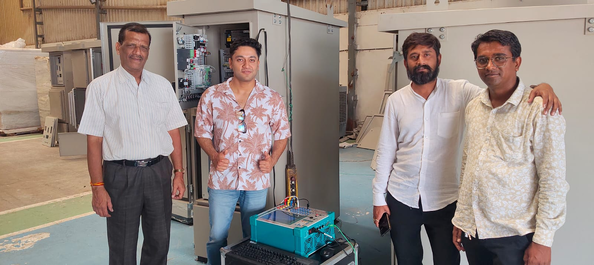
Scene (One)
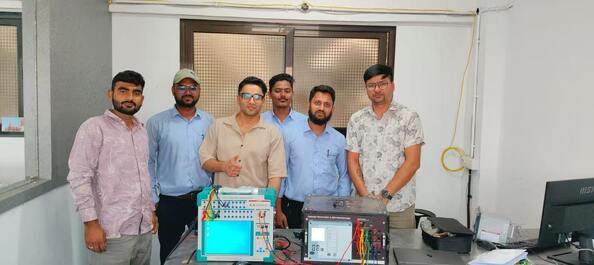
Scene (Two)
Attachment Directory
| No. | Accessory Name | Qty |
|---|---|---|
| 1 | Hand‑held On‑Load Tap Changer Tester Main Unit | 1 set |
| 2 | Color‑coded Test Cables with Alligator Clips | 1 set |
| 3 | Power Adapter & Power Cord | 1 set |
| 4 | USB Data Cable | 1 pc |
| 5 | Grounding Wire | 1 pc |
| 6 | User Operation Manual | 1 copy |
| 7 | Calibration Certificate | 1 copy |
| 8 | Factory Inspection Report | 1 copy |
| 9 | Hard Protective Carrying Case | 1 pc |
Attachment Image
Recommended Products