


All Products
-
 Global Power Solution EngineerStable quality, on-time delivery, reliable long-term partner.
-
 Gulf Electrical Engineering SeProfessional technology and perfect after-sales service.
-
 International Power Research LCustomized solution meets our project requirements perfectly.
-
South America Electric Power PProfessional team, good communication and stable supply.

Fully Automatic Transformer Demagnetizer, Portable Power Transformer Demagnetization Tester


| Place of Origin | Hubei China |
|---|---|
| Brand Name | MINGYANG |
| Model Number | MY-8110 |
| Minimum Order Quantity | 1 |
| Price | 5660USD |
| Packaging Details | carton |
| Delivery Time | 1 week |
| Payment Terms | L/C,D/A,D/P,T/T |
| Supply Ability | 100/Month |
Product Details
| Product Name | Fully Automatic Transformer Demagnetizer | Application | Power Transformer Remanence Elimination, Substation Preventive Test |
|---|---|---|---|
| Operation Mode | Automatic / Manual Demagnetization | Supply Voltage | AC100V-240V ±10% |
| Output Current | 1A/2A/3A/4A/5A Optional | Working Temperature | -10~50℃, ≤85%RH |
| Net Weight | 6kg | Demagnetization Effect | Residual Magnetic Rate ≤5% |
| Highlight | Hipot Tester,Hipot Tester high voltage,Hipot Tester electrical safety |
||
Product Description
Fully Automatic Transformer Demagnetizer, Portable Power Transformer Demagnetization Tester
Product Description
This instrument is a special equipment to eliminate the remanence of large power transformers, and has the functions of demagnetization and verification demagnetization. It plays an extremely important role in protecting the transformer from the impact of magnetizing inrush current, putting it into operation safely and prolonging the life of the transformer.
Product Alias
Transformer Demagnetization Tester / Power Transformer Degaussing Instrument / Transformer Residual Magnetism Eliminator
Features
The instrument adopts the advanced composite current degaussing method, and the current impact is small during the degaussing process.
High degaussing efficiency, only one phase of the three-phase transformer can be eliminated, which greatly saves time.
With manual degaussing and automatic degaussing.
It has the functions of initial residual magnetism detection and residual magnetism detection after demagnetization, and the measurement of demagnetization and residual magnetism can be completed by one wiring.
The wiring is simple, and the test wire of the DC resistance can be directly used for degaussing.
The test results are automatically stored, and the data before and after degaussing are completely recorded, without manual storage.
The management of the analysis software is user-friendly and highly intelligent. After setting the parameters, all measurement work can be completed by pressing one key.
The software interface is simple and intuitive, and the menus such as analysis, storage, report export, and printing are clear at a glance.
Product Parameters
| tem | Specification |
| Input type | current method |
| Output voltage | Vpp-40V, automatically adjusted during testing |
| Output current | 5A, 4A, 3A, 2A, 1A, optional arbitrarily |
| Remanence | 0-100% |
| Degaussing progress | 0-100% |
| Degaussing effect | residual magnetic rate ≤5% |
| Minimum resolution | 0.10% |
| Supply voltage | AC100V-240V ±10% |
| Frequency | 50Hz/60Hz |
| Working environment | -10~50ºC, ≤85%RH |
| Weight | 6kg |

FAQ
Question 1: Demagnetization process failed and terminated halfway
Customer: When performing transformer demagnetization, the instrument automatically stops and prompts demagnetization failure in the middle of the running process. What are the possible reasons?
Manufacturer: First check whether the test connecting wires have poor contact, loose terminal clamps or broken wires. Confirm that the transformer winding is not short-circuited or grounded, and ensure that the transformer has been fully power-off and discharged before connection. Check if the transformer capacity selected on the instrument does not match the actual transformer. Restart the instrument and redo the wiring, then start demagnetization again. If the failure still repeats, stop operation and contact technical support, do not disassemble the instrument cabinet by yourself.
Question 2: Demagnetization completion but residual magnetism still exists
Customer: The instrument shows that demagnetization is finished successfully, but the test result still shows obvious residual magnetism on transformer iron core. How to solve this problem?
Manufacturer: Confirm that the demagnetization wiring is connected to the correct winding terminals, wrong phase wiring will lead to incomplete demagnetization. Check if there are parallel windings or secondary side closed loops on the transformer, these loops will affect the demagnetization effect. Increase the demagnetization cycle times and run the demagnetization program for a second time. Keep the transformer static without external electromagnetic interference during the whole demagnetization process. If the problem remains, consult technical engineers for parameter adjustment guidance.
Question 3: Instrument cannot start demagnetization program after power on
Customer: The instrument can power on normally and the touch screen works, but it cannot enter or start the demagnetization program after selecting transformer parameters. What is the cause?
Manufacturer: Check the connection status of output terminals, the instrument will have interlock protection when output circuit is open or abnormal. Verify the set transformer rated capacity and voltage grade match the actual tested transformer. Check if the internal system has stuck, reboot the whole device and reset all test parameters. Do not modify the built-in system parameters arbitrarily. If it still cannot run, stop using and contact after-sales support, do not open the device shell.
Question 4: Instrument screen displays overcurrent alarm during demagnetization
Customer: After starting demagnetization, the instrument immediately triggers overcurrent alarm and stops working. How to troubleshoot?
Manufacturer: Immediately cut off the power supply of the instrument for safety inspection. Check whether the output test leads are short-circuited to each other or shorted to transformer ground. Confirm that the transformer has not residual voltage and has completed full discharge before test. Check whether the selected transformer parameter is far smaller than the actual transformer specification. Remove all short-circuit risks, rewire and restart test. If alarm recurs, stop test and contact technical support.
Question 5: Unstable touch screen operation during field demagnetization test
Customer: When testing outdoors in substation, the touch screen of the demagnetizer is insensitive or jumps randomly while running demagnetization task. What should we do?
Manufacturer: Check if there is strong electromagnetic interference nearby, such as high voltage live equipment or large power equipment working nearby, move the instrument away from interference source. Check whether the power supply voltage is unstable, use stabilized power supply for power input. Wipe the touch screen surface to remove dust and water vapor. Reboot the instrument to refresh touch system. If touch fault continues, stop the field test and contact technical support, do not replace screen components personally.
Question 6: Shipping Method
Customer: If we place an order, how do you typically ship the goods? Will there be any issues with transporting bulky items such as reactors?
Manufacturer: We default to using dedicated logistics lines or brand-specific express shipping services; small-sized main units and accessories may also be shipped via standard courier services. Large items, such as reactors and excitation transformers, are packed using wooden crates or wooden frames for reinforcement to prevent bumps and moisture exposure during transit; a packing list is included with each package to facilitate item-by-item counting for you. Logistics costs are typically determined by both parties in accordance with the contract terms; after shipment, we will send you both the tracking number and the carrier's contact phone number for easy tracking.If your project site is remote or if delivery to the site is required with a specified logistics company, please inform us in advance when placing your order; we can then coordinate and arrange accordingly.
Question 7: Delivery Lead Time
Customer: Our project is under tight deadlines; how long will it take for the order to be shipped after we place it? Can we request expedited shipping?
Manufacturer: Standard specifications – stock available; typically delivered upon receipt of the order. Orders can be shipped within [X] working days; for non-standard products requiring customized voltage levels, capacities, or reactor combination configurations, the production cycle typically ranges from [X] to [Y] days.The delivery time will be approximately 7-15 working days; the specific timeline shall be subject to the sales confirmation provided upon order placement. If your project has a tight schedule, please inform us of the latest expected delivery date before placing your order; we will first verify the production schedule and inventory status, and where possible, will coordinate expedited production and prioritize shipment. However, it is recommended to allocate sufficient transit time for logistics to avoid delaying on-site testing.
Question 8: After-sales Service and Warranty
Customer: What is the warranty period for this equipment? If any issues arise during on-site use, how will your after-sales service respond?
Manufacturer: We provide a two-year free warranty on the entire unit and lifelong technical support services. During the warranty period, if issues arise due to defects in the equipment itself, we will provide free repair or replacement of components; when problems occur on-site, we commit to responding within 24 hours; most wiring and parameter configuration issues can be resolved through remote guidance via video or telephone; for cases where an on-site visit is necessary, we will arrange for our technicians to arrive at the location to resolve the issue. After the warranty period expires, we still offer repair services, with spare parts supplied at cost price for the long term, and software updates provided free of charge for life. Upon delivery of the equipment, we also offer free operational training (video operation guides)to ensure that your testing personnel can operate the equipment independently and proficiently; should you have any further questions, please feel free to contact our dedicated after-sales hotline directly.
Question 9: Shipping methods for each region (Sea freight)
Customer: Our projects are distributed across several states, and our procurement volumes are substantial; are the shipping methods consistent across all states? How is the delivery time calculated?
Manufacturer: The specifications are identical; however, it should be specifically noted that this equipment set is large in size and heavy in weight—components such as the reactor and excitation transformer are all classified as heavy components. Therefore, regardless of which state or region the shipment is destined for, we will uniformly utilize sea freight transportation. The packaging employs export-grade wooden crates with reinforced structures, along with moisture-proof and rust-proof treatments; the design of these wooden crates is optimized for long-distance sea transport and multiple lifting and transshipment operations. Upon arrival at the destination, simply unpack the goods and conduct an inspection before putting them into use. Regarding delivery time, the sea freight transit period depends on the port of destination: near-sea routes are generally faster, whereas ocean routes may take longer; the exact number of days will be confirmed based on the shipping schedule specified in the bill of lading. We have a dedicated freight forwarding agency to handle booking of shipping space, customs declaration, insurance, and other related procedures; once the vessel departs, we will send you documents such as the bill of lading and the packing list, enabling you to arrange for the receipt of goods at the port of destination and their inland transshipment in advance.
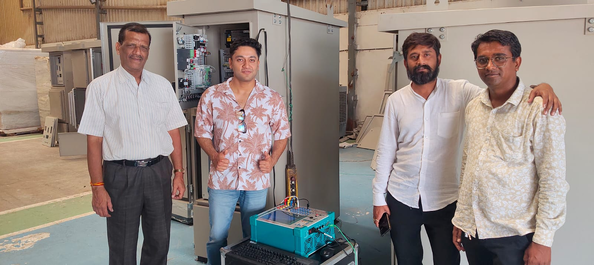
Scene (One)
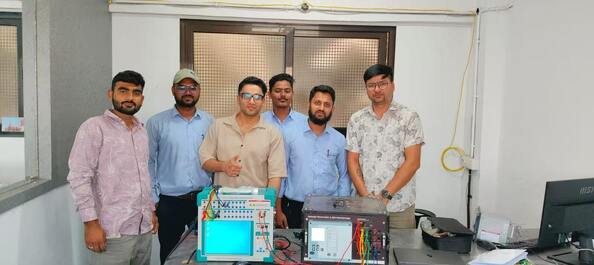
Scene (Two)
Attachment Directory
| No. | Item Name | Qty | Remarks |
|---|---|---|---|
| 1 | Fully Automatic Transformer Demagnetizer Main Unit | 1 set | With touch screen, built-in printer and output terminals |
| 2 | Test Leads | 1 pair | Red and black wires for transformer winding connection |
| 3 | Alligator Test Clips | 2 pcs | For reliable connection on test terminals |
| 4 | Power Supply Cable | 1 pc | AC power input cable for instrument |
| 5 | USB Data Cable | 1 pc | For test data export and PC connection |
| 6 | User Manual | 1 copy | Operation guide and safety instructions |
| 7 | Certificate of Conformity | 1 pc | Factory inspection certification |
| 8 | Thermal Printer Paper | 1 roll | Consumable for built-in thermal printer |
Recommended Products